Background and Motivation
As lithium-ion batteries are increasingly deployed in motor vehicles, concerns regarding their
impact resistance and operational safety have become more prominent. Conventional damage
assessment methods typically require disassembling the battery and conducting prolonged
charge-discharge tests to evaluate the extent of impact-induced damage, which is both
time-consuming and detrimental to battery lifespan.
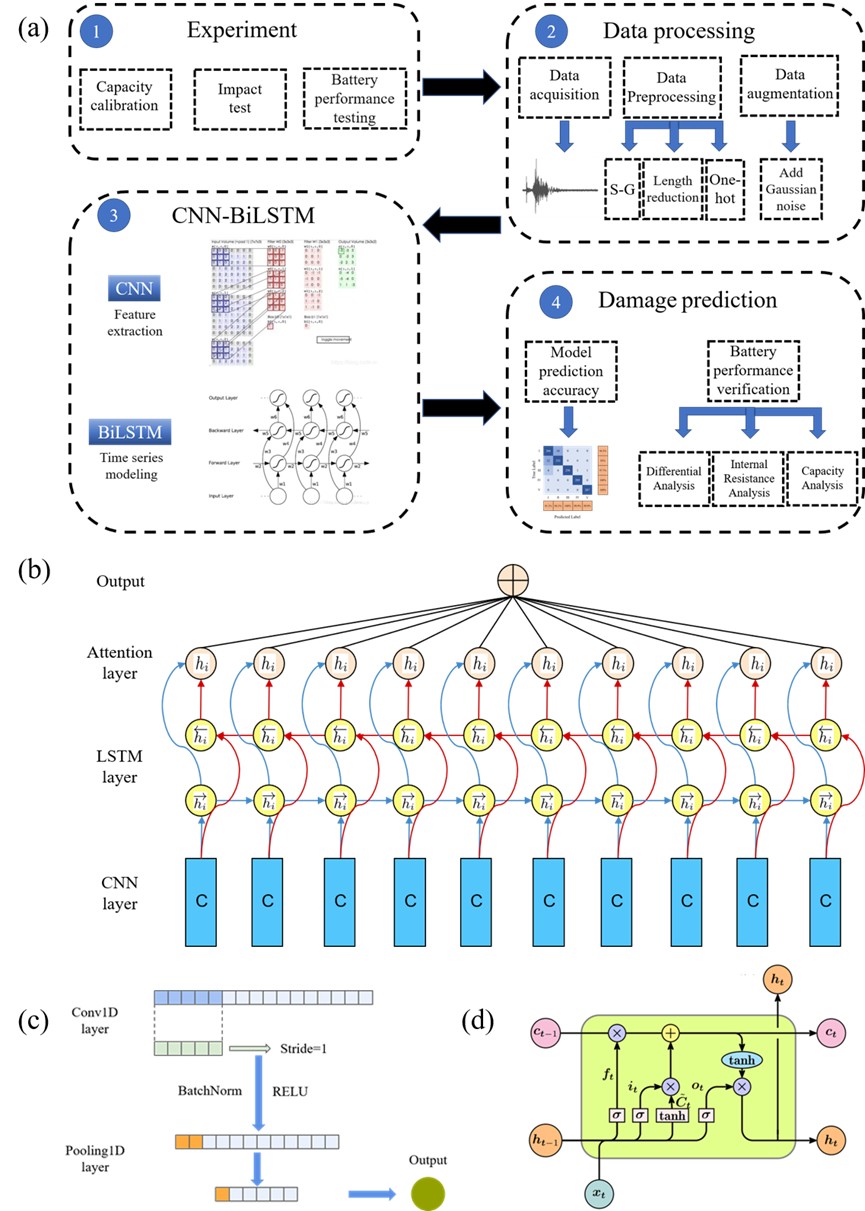
To enable real-time detection and evaluation of impact-induced damage, we propose a
deep learning-based model for real-time damage assessment of lithium-ion batteries after
collision events. The proposed model analyzes input acoustic emission signals and outputs
the corresponding damage level, providing a rapid and non-destructive alternative to
traditional approaches.
Highlights
• CNN-BiLSTM model enables real-time, non-invasive detection of LIBs impact damage
• Model achieves 98.3% accuracy in classifying four levels of internal damage
• AE signals correlate with degradation modes confirmed by electrochemical tests
• Framework supports early safety warning and intelligent battery health management.
Source: Yunfei Deng, Jiangtao Li, Xianglin Huang*, Deep learning-based real-time damage assessment of lithium-ion batteries under dynamic impact, Journal of Power Sources, Volume 662, 2026, 238737, ISSN 0378-7753, https://doi.org/10.1016/j.jpowsour.2025.238737.